

From Doc’s Mailbox
When the Market Blows Through the Expected Move — What It Means for Weekly Iron Condor Sellers

From Doc’s Mailbox: When the Market Blows Through the Expected Move — What It Means for Weekly Iron Condor Sellers
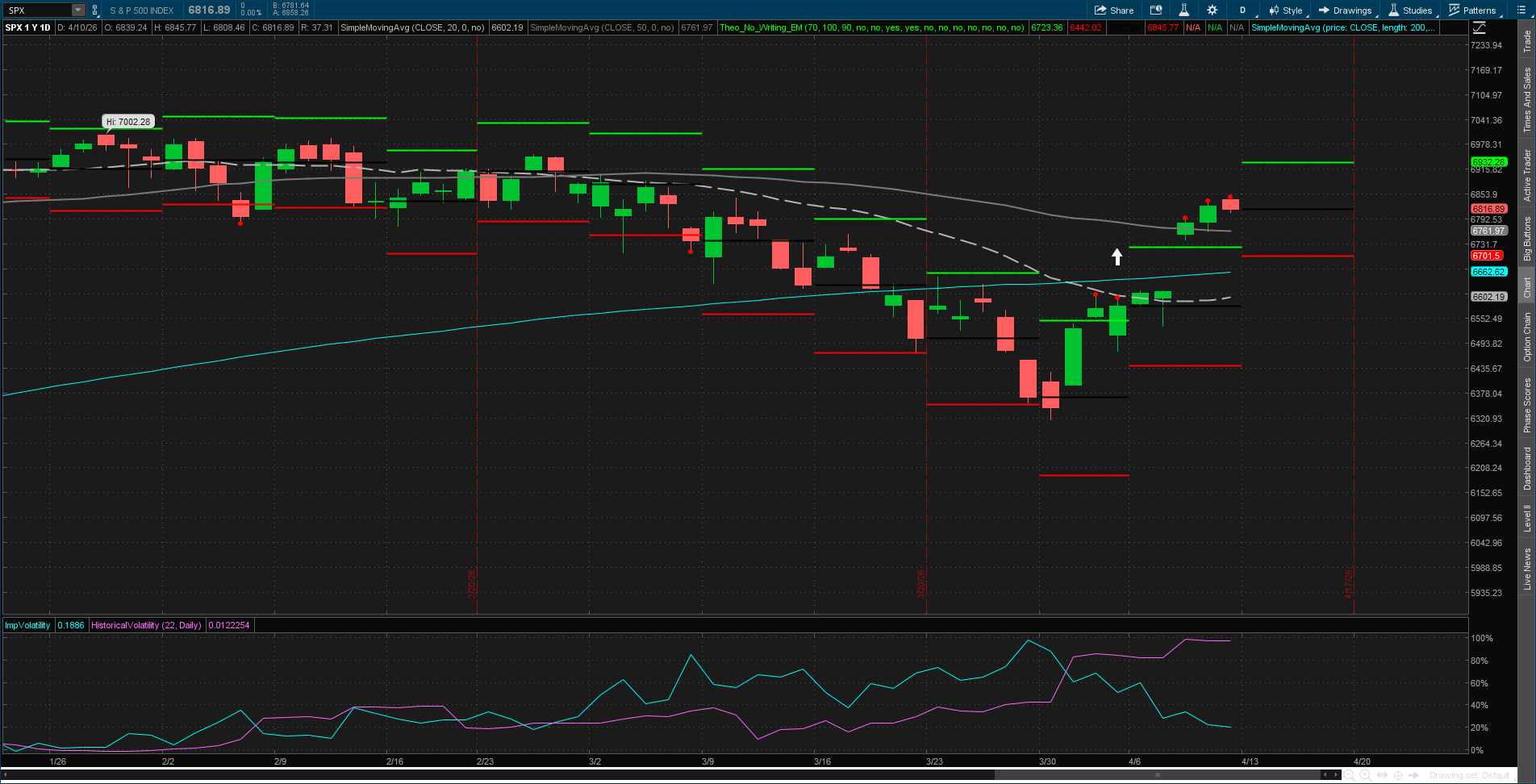
Got a great one this week from a subscriber who noticed SPX punched right through the weekly expected move to the upside and wanted to know — how common is that, really? And since they know I use the expected move as my starting point when evaluating a weekly iron condor, what does it mean when the market just decides to ignore it?
Good question. Let’s get into it
.
First, What the Expected Move Actually Is
The expected move is not a wall. It’s not a promise. It’s the options market’s real-time estimate of a one standard deviation range for the week. And here’s what that actually means: theoretically, we should exceed it 32% of the time. That’s not a bug — that’s the math. One standard deviation contains 68% of outcomes, which means roughly two out of every six weeks, price is supposed to walk outside that range. Anyone selling condors who didn’t know that statistic needs to write it on a sticky note and put it on their monitor.
Now — the good news for sellers is that SPX in practice does a little better than theory. Empirically, the expected move gets breached closer to 20-25% of the time on SPX, because the index has a tendency to mean-revert better than a pure lognormal model assumes. Markets have memory. Models don’t. That gap between 32% theoretical and ~20-25% actual is where a big chunk of the seller’s edge lives. But it’s an edge, not a guarantee, and weeks like this one are the reminder.
One more thing worth clearing up: the expected move lives in the 20-25 delta neighborhood on the weekly chain — not the 16 delta you’ll see cited everywhere as “one standard deviation.” The 16 delta IS your clean 1 SD line, and empirically on SPX it gets breached about 13-15% of the time. Close to theory, slightly better. The expected move — that 20-25 delta zone — is a little closer in, and therefore a little more frequently touched. Know which line you’re standing behind.
The Delta Map
Here’s how I think about the levels. The 20-25 delta is the expected move neighborhood — already a one-in-three event in theory, one-in-four-or-five in practice. Drop to 16 delta and you’re at the cleaner 1 SD line, empirically breached 13-15% of the time on SPX. At 10-12 delta, you’re roughly 1.5x the expected move — that happens maybe 8-10% of weeks. And the 5 delta? That’s 2x the expected move, breached 2-3% of the time. Black swan zip code. The map doesn’t guarantee anything. But knowing where you are on it changes how you size, manage, and think about the week ahead.
The Expectancy Trap
Here’s the part most people miss. The 20 delta iron condor and the 16 delta iron condor have approximately the same expectancy over time. The 20 delta collects more premium per trade but gets tested and breached more often. The 16 delta wins more frequently but the credit is thinner and the math roughly evens out. Neither one has a secret edge in a spreadsheet.
So the real question isn’t which delta “wins.” It’s which one you can actually live with under pressure. If a position gets into trouble at the 20 delta, are you going to manage it rationally — or panic-close at the worst moment? If the latter, go wider and take less. Your psychology is part of the edge. QUANTUITION isn’t just the math — it’s 40 years of knowing what you’ll actually do under pressure and building your structure around that reality.
How I Actually Run It
The expected move is the beginning of the evaluation process, not the verdict. I use it to frame the range, then I layer in something that most pure premium sellers skip entirely — and that’s where the large market maker gamma levels are sitting.
Here’s why that matters. When customers are net short options — which is the typical retail positioning — market makers are on the other side, net long gamma. Long gamma above the market means they’re long calls at those strikes. Long gamma below means they’re long puts. And when market makers are long gamma at a level, they are natural sellers into strength above it and buyers into weakness below it. That’s not charity — that’s their hedge. They have to sell the rallies and buy the dips to stay delta neutral. The practical effect is that those levels act as shock absorbers. Price tends to get sticky, slow down, or reject near them.
So when I’m placing iron condor strikes, I’m looking at the expected move multiples AND asking where the major long gamma clusters are. If the 20 delta call strike happens to sit right on top of a large market maker long gamma level, that’s confluence — the probability math and the structural flow are pointing at the same place. That’s a strike I feel better about. Conversely, if the expected move range sits in a gamma vacuum — no big dealer positioning to slow things down — I either go wider or I think twice about the trade altogether.
The delta map tells you the probability. The gamma map tells you whether the market structure supports it. Used together, they’re a lot more powerful than either one alone. That’s the combination. That’s QUANTUITION.
Closing at 25-50% of max credit means theta has done its job and you’re out clean. No hero holding. The trade that closes at 40% of max on a Tuesday is a win. You don’t need the last dollar. The last dollar is where the headaches live.
On wing width: 5-point spreads work for scaling. 10-point wide is the sweet spot for most weekly SPX traders — better feel on credit-to-risk. Go much wider and you’ve basically built a strangle with a security blanket. Which isn’t terrible, just own what it is.
What I’m Watching Going Into This Week
